

The science

Heart attacks aren't random. They're measurable years in advance.

The biology of soft plaque, why standard tests miss it, and how modern imaging plus AI changes the equation entirely.

0 sec

How often someone in the U.S. has a heart attack. 40% don't survive the first one.

0 in 10

Heart attacks driven by soft plaque — invisible to stress tests, EKGs, and calcium scores.

“Fine”

What most people are told at their last checkup — weeks before the event no one saw coming.

Heart disease is the #1 killer in America — and almost no one sees it coming. It doesn't have to be you.

You've been lied to

The tests you trust were never designed to save you.

For decades, standard heart screenings — stress tests, EKGs, and even calcium scores — have lulled millions into a dangerous false sense of security. These tests can't see the real threat: they only detect blockages, the final stage of the disease, often after it's been silently growing for years.

But heart attacks rarely come from full blockages. They come from microscopic soft plaque rupturing without warning — hiding inside the artery wall where only a 640-slice cardiac CT angiogram (CCTA) layered with FDA-cleared AI can see it. The result of testing the wrong thing? Doctors wait. Insurance stalls. And people who "feel fine" and "pass every checkup" collapse without warning.

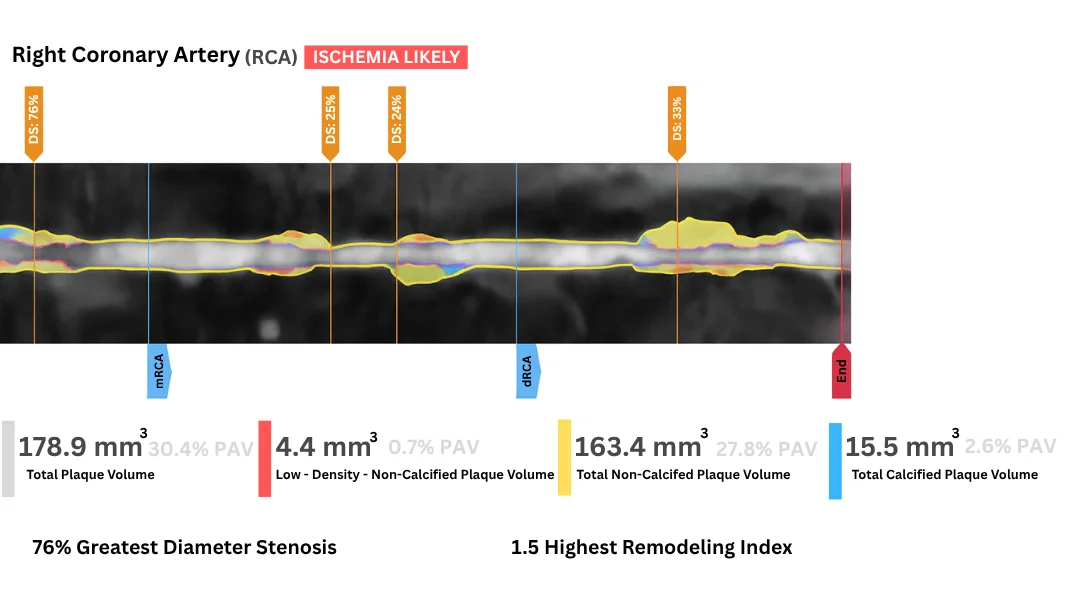
  • The soft yellow areas are non-calcified, rupture-prone plaque
  • AI maps exact narrowing points — including one at 76% diameter stenosis
  • None of this would show up on a stress test
  • In this scan, a calcium score would detect only 2% of the disease

This isn't prevention. It's reactive medicine, built to respond after the damage is done — and it's failing every 38 seconds.

Actual AI-enhanced scan of the right coronary artery — plaque volumes quantified down to a tenth of a cubic millimeter. This is what most cardiologists never look at. And this is what causes most heart attacks.

Why "passing" a stress test means less than you think

A stress test only turns positive when an artery is roughly 70% blocked. Most heart attacks happen at plaques narrowing the artery far less than that — they rupture suddenly, forming a clot that blocks the vessel in minutes. That's why people pass a stress test and have an event weeks later: the test was answering a different question.

The calcium score's blind spot

Calcium scoring only detects hardened, calcified plaque — the older, more stable kind. The soft, lipid-rich plaque that ruptures is invisible to it. A zero score is good news, but it is not a clean bill of health. Soft plaque hides inside the artery wall, where only CCTA can see it.

What 640-slice CCTA + AI actually measures

The scan captures the entire coronary tree in high definition. FDA-cleared AI then quantifies every plaque by volume, density, composition and location — to a tenth of a cubic millimeter. You get a precise map: how much plaque, what kind, where, and how fast it changes between scans.

Reversal is real — and measurable

With aggressive lipid management, blood-pressure control, and targeted lifestyle medicine, soft plaque can stabilize and regress. Because your plaque is quantified, the plan's success isn't a feeling — it's a number you can watch go down on your follow-up scan.

Book a call

Stop guessing. Get real answers about your heart.

Apply to become a ClearCardio patient. Our Patient Assessment Team will review your history, symptoms, risk factors and prior tests — and confirm if the program is right for you. Real answers in as little as 7 days.

  • HIPAA compliant
  • No obligation — step 1 is a conversation, not a commitment
  • Reviewed by Dr. Osborne's Patient Assessment Team

Request your Heart Clarity Call

We'll never share your information. Submitting this is not a medical diagnosis.

Book your Heart Clarity Call